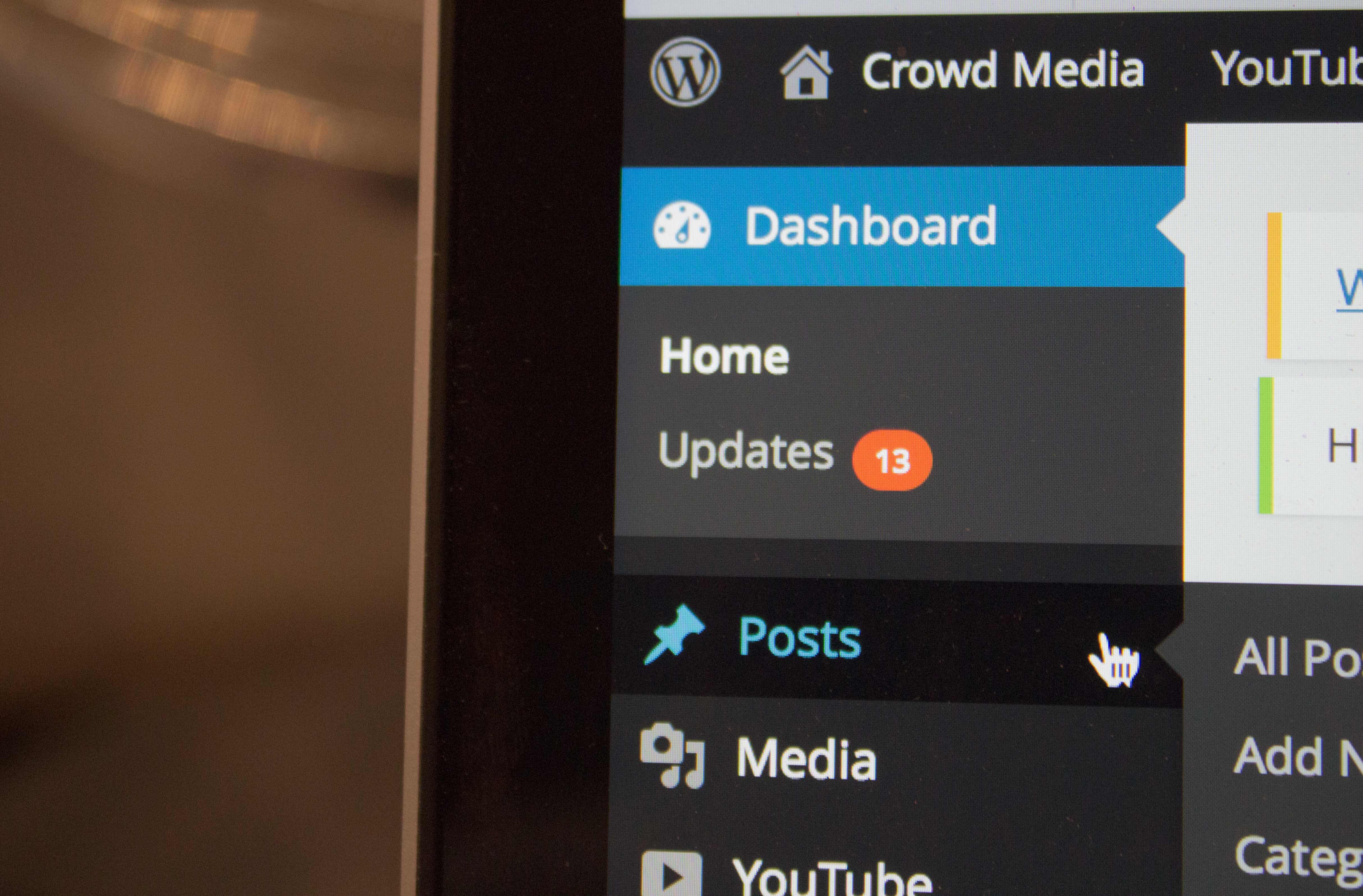
Crowd design and develop websites for a wide range of clients, each with differing wants, needs and expectations. While we are adept at creating fully bespoke content management systems (if that is really what you want), often we recommend open source frameworks as a basis for website development. WordPress being one example, Joomla and Drupal a couple more you may have heard of.
But why?
Here’s a few simple reasons why we like WordPress, and other open source solutions.
Open Source…
‘denoting software for which the original source code is made freely available and may be redistributed and modified’
The WordPress Content Management System and other open source alternatives are freely available products that provide a bare bones CMS framework to be used as a basis for updating and editing websites.
Available to designers and developers to freely integrate into projects, ‘they’ can be used, re-used and built upon to provide a multitude of solutions to meet specific requirements – and, most likely, your requirements too.
‘Open source’ status renders WordPress and other similar products extremely versatile, and potentially cost effective.
So next time someone tells you ‘don’t go open source it won’t meet your requirements’ or ‘you need an entirely bespoke solution’ ask them the price of their alternative, how long it will take, and be sure to politely question their motives.
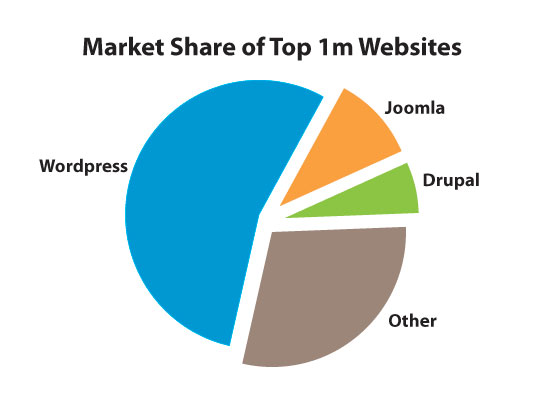
Breakdown of websites with a clearly identifiable CMS, according to W3Tech’s survey of the top 1 million domains
Community driven development has its perks…
Open source products are by their very nature community driven; designers and developers from across the world are able to contribute to the improvement of ‘the platform’ (your CMS) by developing new plug-ins, modifications and applications that can offer solutions to meet specific requirements.
What this means to the uninitiated is that these frameworks are constantly evolving and adapting (unlike bespoke alternatives), offering new capabilities and improvements, that you can benefit from. All of this serves to help provide versatile and expandable solutions.
MYTH: WordPress is just a lightweight blogging platform
In it’s infancy, May 27th, 2003 to be exact, WordPress was developed primarily as a blogging platform and didn’t have the plethora of features required to be described as a fully ‘fledged CMS’. This is a distant memory and anyone who says otherwise clinging to the past or an out dated business model.
We’ve already established how widespread the use of WordPress is; the volume of initial blogging usage and hence it’s widespread familiarity are contributing factors to its continued and rapid evolution and widespread adoption.
Usability matters
The collaborative evolution and widespread use of open source content management systems means that they really get put through their paces by both developers and end users alike.
This is like a form of testing en masse; resulting in rigorous change and improvement from source version to version. Imagine having access to a product that millions and millions of people have tested time and time again? Well you can! The result of this collaboration and input from various perspectives is that you end up with a CMS that is highly usable and intuitive.
Great! you say…but what if I still don’t get it…
In our experience a wide demographic are able to quickly get to grips with a CMS with a little training; but if you need a mind jog, a core advantage of open source CMS products are how thoroughly documented they are in the form of written guides, video tutorials and other freely available media. The advantage being self reliance, an understandable prerequisite of many clients that can help keep budgets in check. (If all else fails we’re still here to help!)
Next time someone tells you ‘this CMS is better than that CMS’ tell them you know better…
The best CMS is what you make it…not how it comes out of the box…
In general terms there is no ‘best CMS’. There are numerous products available that have their advantages and disadvantages out of the box (each of which can be built upon and customised by developers); WordPress, Joomla, Drupal and many other open source products provide a solid foundation for developing an effective CMS without re-inventing the wheel, but selecting ‘the best’ is subjective and to a large degree, the suitability of a CMS should be judged on how well it accommodates the specific requirements of the client or website in question. Discussing ‘the best CMS’ in general terms is a total waste of time, as there are simply far too many variables to take into account.
Want to talk more about how using open source platforms can enhance your online presence and business processes?
Mail Crowd on hello@crowdmedia.co.uk or give us a call on 01481 721632.